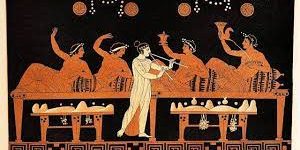
L’espansione della vite e del vino riguardava esclusivamente le classi dominanti che lo importarono a caro prezzo dai territori caucasici e il wine veniva considerato come una bevanda speciale utilizzata quasi esclusivamente per rituali pubblici religioso-politici.
“Wine displayed creates social distinction, wine shared creates caste cohesion”
Wine consumption expanded to the more affluent segments of the population, it was integrato nella vita sociale e religiosa and myths about wine were created by local deities and characters. At this point the the table-wine connection is inevitable, essendo prassi universale celebrare occasioni solenni con un pranzo sontuoso.
Nella Grecia arcaica the banchetto era un momento di allegria e di culto of collective memory: the male diners, seated in the megaron (the most luxurious hall) in front of a small table, ate meat and drank wine listening to the bard.
Nella Grecia classica le occasioni per banchetti were not lacking: a city festival, a sports victory, a legislative proposal to discuss.
Essi si tenevano in una stanza riservata agli uomini ed erano articolati in due tempi distinti: quello in cui si mangiava e quello in cui si beveva.
In the symposium, wine was a sacred drug: in addition to creating intellectual communion with friends, it established a physical and ecstatic relationship with the divine.
Aristocratic Greek women lived confined at home and were excluded from what men considered the real world: agora, courts, assemblies, gymnasiums, the table and wine.
In general, they were uneducated and men had a low opinion of their intellectual abilities.
Male sociality was expressed in the symposium where it found religious meaning, social confirmation and entertainment (poetic and musical exchanges, games, eroticism). The men of the symposium could be joined, as companions for an evening, by professional entertainers (musicians and hetaerae), who ensured service and entertainment.
But where and when did the mental shift happen?
There novelty di un woman-wine duo vissuto in senso positivo was realised with the Etruscanschi, che avevano adottato con entusiasmo le pratiche conviviali greche, ma banchettavano con le loro mogli, in a climate of equality that for the Greeks was an incomprehensible perversion. The historian Theopompus, in the second half of the fourth century BC, noted with scandal:
“Le donne etrusche pranzano accanto a chi vogliono loro, bevono alla salute di chi vogliono loro e sono forti bevitrici”

 EN
EN  IT
IT